LA CHINAMPERÍA
Photos and Text by
Mat Hay
Through the mist that forms each dawn under cold dark blue skies we navigated our way between black overhanging trees towards a lagoon in the distance. My guides, chinampero farmers Felipe Barrera Aguirre and his daughter Mixtli, paddled their canoe gently towards the small sacred island in its center. Gathering on its grassy surface and surrounded by plump cactus we looked east towards the revered Popocatépetl ‘Smoking Mountain’, as little clouds of white gas floated from its snow capped summit crater, backlit gold by the rising sun. It felt like we were re-enacting what Felipe and Mixtli’s ancestors have done since before even the Mexica (Aztecs) arrived in the Valley of Mexico, and in some ways that not much has changed. The reality though is that in recent times, almost everything has.
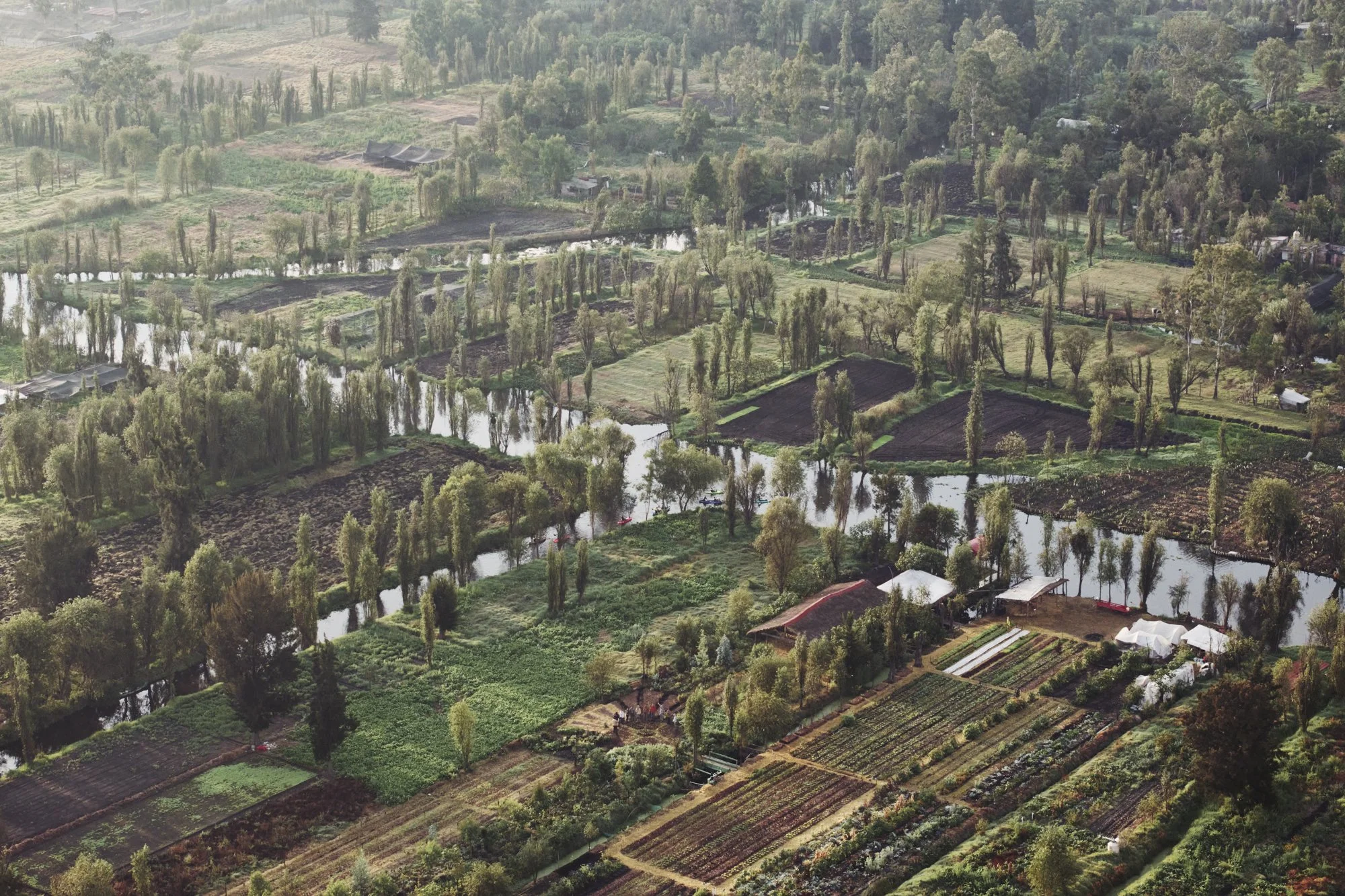
We were in the heart of the Chinampas, a vast network of man made islands and canals located in southeast Mexico City. These ‘Floating Gardens’ were first built in the shallows and marshland of Lake Xochimilco, one of several interconnected lakes that once filled the valley now covered by the capital. Maintained to this day by predominantly traditional farmers known as chinamperos, many of whom still speak the Mexica language of Náhuatl, this UNESCO world heritage site is recognised as a Globally Important Agricultural Heritage System and, together with the ecological reserve to its north, a RAMSAR Wetland of International Importance under the Mexican government’s protection.
The agroecology practiced here is highly productive, with up to seven harvests a year supplying thousands of tons of food annually to markets across the city. And with only a fraction of the possible 21,000 total chinampas currently operating, it is estimated if the area was restored it could provide millions of residents of Mexico City with organic produce.
Chinampas also offer solutions for dealing with limited resources across a warming and increasingly unstable planet, demonstrating how a productive, sustainable, and organic polyculture can be implemented wherever people live close to rivers, lakes, or swampland. From major urban environments to small rural locations, the benefits of raised field systems like these are significant. They increase food security, providing high yield and diverse crops, and even livestock, while eliminating food miles and the use of polluting agrochemicals and plastics.
For a hot and crowded megacity such as Mexico’s capital, the chinampas and wetland now serve as an increasingly vital reservoir of water that replenishes the faltering underground aquifers that have almost run dry, while cooling the city streets above by an estimated 2C.
They also host rich ecosystems in an area where the natural environment has been greatly reduced, and every hectare of chinampa sequesters 110 tons of carbon annually.
Despite all this, the Chinampería (as it is collectively known) faces an uncertain future. Everything from its culture, farming, and biodiversity, to the wetland it is symbiotically linked to is under threat. The number of chinamperos has dwindled as youngsters move into a city slowly enveloping their land. Natural springs that once filled the canals with drinkable water have been diverted to upmarket neighborhoods downtown and replaced by gray water from treatment plants, sewage from illegal housing, and toxic pesticides, chemicals, and plastic waste from modern industrial farming and floriculture practices often brought in by farmers from other regions.
Many of these problems stem from apathy or derision towards rural communities from society. And for many people the chinampas have become just a novelty tourist destination, somewhere to visit on weekends to drink and party while cruising on the canals. Or they come simply for space the city no longer has for recreation, like the football pitches being built over less profitable chinampas.
However, a passionate new generation of farmers and scientists are working towards its future. Implementing conservation and rehabilitation projects, developing responsible eco-tourism, and combining resources, knowledge, and technology to supply more quality conscious customers with their organic produce.
Another important development has been the founding of the first chinampa school teaching Agroecology, Culture and History, Art, Cuisine, and science backed Traditional Medicine. The farming collective behind it hope the broad curriculum will teach students not only to be farmers, but help them become chinamperos and the next guardians of the Chinampería.
To learn more about the Chinampero community and how they have lived symbiotically with nature for more than 1000 years, and to discover how they are trying to safeguard its future, I began working with a number of chinamperos, documenting life inside their unique wetland home while investigating their complex struggle for survival.
THE CHINAMPERO
The phrase La Chinampería is a broad term that technically refers to the Chinampero community and the wetland they preside over, their farming, their culture, and their reverential ethos towards nature and the environment. To Felipe Barrera Aguirre, who’s Chinampero heritage stretches back generations, it means much more…
“La Chinampería is life itself, it is the origin of our culture, it is the origin of the heart of Mexico, if the Chinampería had not existed, Mexico would not be the Mexico we know.“
“If these problems are not fixed, our history, my history, my family's history, is going to end (and) apart from losing this historical memory, the city itself is also lost, because there would no longer be water…
…This opportunity to have this land so rich, so fertile to produce food, that opportunity would also be lost, and we would be talking about a possible collapse of Mexico City …and we still have time.”
(below) Mixtli and her father Felipe visit Laguna de Tezhuilo (which means water mirror) where springs once filled the chinampas with water clean enough people would drink straight from the canals.The community still hold rituals and celebrations in these sacred lagoons, which at one time where accessible only on special occasions in order to preserve the water and wildlife that breed here, but are now visited by increasing numbers of tourist boats and kayaking tours.
THE YOUNG CHINAMPERA
Maintaining a deep respect for the community and its environmental values, biology student Mixtli is part of an environmentally savvy and passionate community of young people from surrounding areas and across the city bringing energy and resourcefulness into the chinampas. Aware that traditional communities often must adapt as society changes around them, and that change can be steered in a positive direction, Mixtli aims to combine her university studies with the traditional skills passed down from her father and other mentors to work on conservation projects in the area, to help strengthen the community.
“My dad, as a chinampero and as a person, has completely influenced how I think and how I relate to living beings. It is because of him that I studied biology, due to this connection I have always had with nature.”
“Here in the chinampa, it's an infinite world of things happening in the soil, in the water, in the crops, and he has made me pay attention to all these processes that are so important for life to continue existing and reproducing.”
(above) Mixtli and Felipe clear excess vegetation from their private canal. With help from other members of their farming collective, they installed biofilters at each end to keep out pollutants and invasive fish present in the main waterways that have decimated native populations of the revered axolotl salamander.
Explaining how in the coming months, she and a group of friends plan to reclaim and start rebuilding an abandoned chinampa nearby, Mixtli tells me “…Among all of us, we aim to turn it into an open space for people questioning various aspects of city living and understanding how this significant space is integrated into the urban environment. Also to explore how one person can initiate a process in which we build collectively.”
“In the future, I would like more young individuals, like myself, to embrace the identity of being Chinamperas and Chinamperos. Through this, I hope that the Chinampas can be restored, driven by our shared interest.”
“If the Chinampas disappear, it is just a reflection of this general mindset in societies, this Western belief that nature or spaces are at the service of human beings and nothing more …It is crucial to recognize ourselves as an integral part of this whole, so that we do not continue on this path we have been following for so long.
These lands suffer from abandonment, they suffer from being forgotten by the new generations, and by reclaiming them, I am engaging in a political act
I can't imagine a world where there aren't Chinampas, but that's why I'm here, to ensure that doesn't happen.”
Along with passing on his philosophy and knowledge of agroecology to his daughter, Felipe also hosts students and other groups at his chinampa where vegetables and flowers grow alongside axolotl sanctuaries.
BIOLOGISTS
Recent graduates from universities across the city come to monitor axolotls placed in a purpose-built underwater cage. Run by the Ecological Restoration Laboratory at the National Autonomous University of Mexico (UNAM), the Chinampa-Refuge project works with a number of chinamperos to reintroduce these amphibians back into the area where they once thrived, and in doing so, restoring the land and water quality of that area.
Hydrobiologist Vivian Crespo (in checked shirt) explains her motivations for working on the project;
“In the future I would like people to understand and comprehend the importance of conserving this ecosystem because whether we want it or not, we need it and it needs us.”
(below left) After removing a protective cage from the water, environmental biologist Paola Cervantes climbs inside to retrieve the axolotls.
With an interest in environmental sciences and ecological restoration, the third member of the group Fatima Marichi Gallardo plans to use the skills she’s developed here to study ecosystems across Mexico and further afield. For now though, she hopes the Chinampa-Refuge project will highlight the benefits of traditional farming systems over heavy polluting and aggressive modern agriculture methods.
FARMING
(above) Ahuejote trees line the more industrial and densely packed farms of San Gregorio Atlapulco. While their canopy provides shade for workers, their slender roots form the outer structure of chinampas, which begin as staked-out islands infilled with organic matter and nutrient rich sediment pulled from surrounding canals, marshes, or lakes.
With crops going from seed to harvest on average every two months, farmers can easily adapt to changing markets. Cousins Eva Fragoso Galicia and Andrés Galicia Hernández had never tasted kale before, but when it became popular in the city they switched production to capitalise on demand.
“For me, (Eva and Andrés) have a magnificent production system, with different persons helping and doing what they are best at. For example, Eva is a postharvest expert and Andrés … is a traditional techniques master.” Raúl Mondragon, co-founder of Colectivo Ahuejote, who began working with the cousins to help with distribution and accessing more customers in the city.
Fives times a week Andrés and his nephew Juán Carlos wind their way through a warren of farms and canals, taking fresh produce to their collective’s distributer waiting for them in town. En route he travels over canals that should be filled with fresh water, but are currently stagnant and almost empty.
Although San Gregorio Atlapulco is the most dense and productive of the five chinampa zones, one pipe leading from Xochimilco tightly restricts the amount of extra water it receives, leading to the levels and quality declining in many of their canals. According to the locals Xochimilco takes priority over the water because of the presence of tourism over there.
Recently, suspected plans to extract more water from the area, further reducing the water that reaches San Gregorio Atlapulco and its farms, resulted in protests and violent clashes. During a visit in late 2023 my guide explained how the water supply to his whole neighbourhood had been shut off for several weeks because of a fault that hadn’t been fixed. He took us to the only source of drinkable water available to local residents; a tiny plastic pipe that had been tapped into one of the aqueducts taking clean water downtown. According to residents here the growing unrest in San Gregorio Atlapulco is a result of neglect and bias against their predominantly Indigenous community.
(below) Some of the more spacious farms in Xochimilco, where water levels were much higher.
THE NATURE RESERVE
Dawn at the Laguna de San Gregorio Atlapulco looking south toward the chinampas and neighbourhood of San Gregorio Atlapulco. The lagoon and surrounding ecological reserve have been designated a RAMSAR Wetland of International Importance and are under the protection of the Mexican government.
Local beekeeper Sergio Castillo Cerraldi shows me around the wetland and where he tends his hives. He told me that due to urbanisation across the valley “…the nature reserve is one of the last water bodies in Mexico City… the only place without asphalt where migratory birds can land.”
(below right) Sergio’s neighbour and cattle farmer José Pascual
Returning from Sergio’s we pass through the centre of the ecological reserve. Despite its protected status there are old tyres, plastic, and detritus sporadically scattered around, and we can see the whole eastern section has been scorched by fire (below left). Sergio says this was caused by people leaving trash including smashed glass.
When asked who is responsible for maintaining the ecological reserve Sergio says it’s ultimately left to the community “…and the governors are (its) biggest threat; the agrochemicals and demagogy are the weapons.”
A BIOLOGIST - MAPPING THE CHANGING LANDSCAPE
In San Gregorio Atlapulco I met with biology student Celic Sánchez González. For her degree thesis she conducted interviews and workshops with members of the Chinampayolo and Chinampa San Sebastián collectives to create a detailed illustration of the entire Chinampería, highlighting the numerous issues it faces.
While explaining her motivations for creating the map she showed me round the site of a sewage outlet flowing directly into the canals (below right), and where emergency efforts are being made to pump more water into the canals and farming areas (below left).
It's also an exercise in memory and recognition of the territory. This map proposes that this system undergoes periodic changes because the territory is not static. Even though we conducted the workshops in 2022, by the end of last year, during our workshop with the chinampa farmers, there were already changes. Things had shifted; what was happening now had expanded to different areas. The territory is constantly changing, so these exercises are things that need to be done regularly to stay informed about what is happening in the territory.”
“This map can help us identify priority areas that need immediate attention and it can also help us start thinking about direct action strategies. Sometimes, we need strategies that address broader issues because when we are too focused, we lose sight that this is a large system, and its current situation stems from socio-economic and political conditions that are beyond the chinampa farmers themselves. So, the purpose of the map is to help visualize and pinpoint priority areas for attention.
Celic’s map shows locations affected by water extraction, grey water and sewage outlets, water shortages, illegal housing and trash, tourism, and urban encroachment; Like Puente Vehicular de Cuemanco (below), the freeway bridge built over the north west section of wetland, or the recent influx of sunrise kayaking tours into sacred lagoons (2). Also included are the growing number of football pitches (25) that sit empty during most weekdays but can still provide more income than farming.

(above) Canals that once stretched all the way to the historical centre of Mexico City come to an end at the northern most point of the Chinampería.
(below) Due to a lack of green spaces in the capital, large sections of the northern wetland have been converted into recreational facilities that, like the football pitches, are mostly empty during weekdays.
ENCROACHING INTO THE CANALS
(above and below) Canals lead directly into the heart of Xochimilco
Constructing poly tunnels, green houses, and other agricultural buildings on chinampas can be the first stage in urban encroachment.
(above left) Although building and human habitation is officially restricted here, illegal housing is common, which leads to trash and waste water being dumped into the canals. Signs of habitation are the thin black tubes carrying drinking water between homes breaching the water surface while electric cables span overhead.
(above right) Large submerged aqueducts crisscross hillside neighbourhoods diverting spring water to the city before it reaches the chinampas .
(above left) Morning at the Yucatán lock and people commute through the outlet from a water treatment plant. Locals say both the volume and quality of water the canals receive is below what has been promised.
(above) Running directly from San Gregorio Atlapulco to the Central Market in downtown Xochimilco, the busy Avenue Nuevo León is crammed with shops, businesses, and homes, and a canal running almost its entire length.
Driving this road gives a sense of the pressure canals come under as the city envelopes them. Although a natural volcanic filtration system has been installed at this section, which the municipal workers in green were maintaining, the stench of pollution here is intense.

Mention chinampas to those familiar and what many people think of are the brightly coloured trajineras like the ones jostling for position at Embarcadero Nuevo Nativitas, one of several tourist hot spots around town. Families, couples, and friends come here to enjoy the fiesta atmosphere, partying amongst the vendors and Mariachi bands going from boat to boat.
Dr Refugio Rodríguez Vázquez, a biotechnology and bioengineering professor at the Centre for Research and Advanced Studies at the National Poltechnic Institute hopes this staple of Xochimilco’s sizable tourist trade could play a part in improving the area’s declining water quality.
At her nearby education and test facility she demonstrated a number of other projects she is working on, including biofilters being installed on participating farmers’ land, and machines that release nano-bubles of air into the canals to neutralise the pathogens building up because of toxic chemicals, sewage, and invasive plants choking the water of life and releasing greenhouse gasses into the atmosphere.
With the help of willing boat company owners and government funding Dr Rodríguez Vázquez hopes to install these small solar powered units onto whole fleets of trajineras throughout the area.
FARMING COLLECTIVES
Established in 2017, Colectivo Ahuejote (CA) is a local NGO initiative working to reactivate and empower Chinampera agriculture, with the ultimate goal of achieving food security for Mexico City. Its co-founder Raúl Mondragon explained their process; “We work with chinampero peasants and small-scale producers with a capacity building program focused on three components: agroecological production, commercialization and logistics, and community organization through practical workshops and reflection processes to achieve our objectives.”
Raúl (below left) chats to Ernesto Reyes Perez, a member of CA and someone Raúl believes is progressing modern chinampera agriculture. “Ernesto is a cool chinampero. He’s young and curious, eager to explore and discover how to achieve a full sustainable chinampa. He’s been experimenting with different ecotechnologies like solar power plants for irrigation systems or water filtration systems …his work is interesting, and it could be a role model for the Chinampería.”
The land surrounding Ernesto’s farm is mostly used for growing ornamental plants, and the presence of the modern version of this industry in the chinampas was of concern to people throughout the area. The issue stems from ornamental farmers, who often come from other parts of Mexico, using industrial techniques involving pesticides and chemicals, growing each plant in a single black plastic bag (right) filled with soil usually imported from the mountains.
The chemicals and plastic find their way into the soil and surrounding water, which impacts the traditional farmers and the environment around them.
(centre) Ernesto holds volcanic rock from one of the water filtration systems built on his land in collaboration with Dr Rodríguez Vazquez.
(below) Ernesto and his wife Lourdes entertain their daughter Valentina, watched over by his stepfather Angél, Rocky the german shepherd, and Simba the pug.
As the sound of barking dogs and bassy popular folk music pumping from loudspeakers on neighbouring ornamental chinampas drifts through the evening air we discuss projects Ernesto is working on, like removing all the black plastic from the soil and building his own canals, filtration systems, and an axolotl sanctuary. Explaining his motivations, he says getting organic certification will provide financial benefits of course, and give customers high quality local produce.
But through his previous studies in urbanism and working for the government in the area he’s become more aware of the human footprint and really feels it’s about doing the right thing here. And creating a space where his daughter can pick something straight from the earth and eat it, or go swim with their axolotls. “Its important to give something back to nature and to show you can live in balance.”
Flowers are still grown the traditional way alongside vegetables at the chinampa of Olintlalli (meaning ‘land in motion’ in Náhuatl), an organization focussed on conservation through sustainable modern ecotourism. Well respected amongst the broader community, the family run collective offer numerous experiences for visitors at their immaculately presented chinampa and recreational grounds.
This includes classes in agroecology, canal tours, traditional ceremonies, and night time recitals revealing the myths and legends of Xochimilco’s oral history.
Inside Olintlalli’s temazcal where hot volcanic rocks are doused in herb infused water during an hours-long traditional cleansing ceremony.
14 year old Yatziry Telléz Del Valle joins her father, uncles, and grandfather packaging up fresh organic herbs to ship to one of Olintlalli’s customers.
While chinamperos do supply smaller markets, restaurants, and consumers directly, the majority of produce goes to the Central De Abastos market in the city, which at over 800 acres is the largest wholesale market in the world.
(above) Produce at the San Gregorio Atlapulco market.
Dawn in the nature reserve looking towards the chinampas and hillside neighbourhoods of San Gregorio Atlapulco. 35 miles to the east volcanic gases drift from the 5,426m summit of stratovolcano Popocatépetl, the ‘Smoking Mountain’, affectionately referred to by locals as ‘El Popo’.
Germán Diaz Jimenez guides myself and Colectivo Ahuejote’s Communications Coordinator Francesca Verschoor through the morning mist to his chinampa.
(below right) Dawn at Laguna Tlilac with El Popo in the distance.
Introducing tourism and recreation spaces into the area is an opportunity to increase income for locals, but this often comes at the detriment of the chinampas and its wildlife. Like, for example, cutting down trees and filling in canals to make space for recreational spaces that subsequently increase the volume of motorized traffic required to cater for visitors.
However, Germán believes change shouldn’t come at a cost and, like his Nahua ancestors before him, that respecting the environment around him will protect his own future.
Román Martinez (above left) prepares our breakfast of chicharron with eggs and tomatoes, beans, tortilla, and diced papaya. A carpenter by trade, Román is helping Germán build a new center for traditional eco-and-agrotourism. The proceeds from this and the high-quality produce from his chinampa will help fund conservation in the area, which in turn will help maintain the quality of his produce and keep people coming back to learn about the Chinampería.
(above right) Migratory pelicans fly above the slender ahuejote trees on Germán’s chinampa towards Laguna Tlilac (below)
THE CHINAMPA SCHOOL
Escuela Chinampera Tlamachtiloyan Chinampaneca
The creation of the first ever chinampa school has been an important milestone in the struggle to safeguard the future of the Chinampería. Attracting youngsters into a life of farming can be a difficult task in modern times, especially when your farmland sits within the boundary of a mega-city. However daunting their task is, and even with extensive setbacks and delays to the program, Felipe and his fellow teachers display an optimistic and unwavering sense of obligation to both future generations, and their ancestors..
“The Chinampera School is an invitation to our entire community, to the youth, to come to the chinampa and learn.
…It covers the agricultural aspect, agroecology, water and land conservation, cooking, traditional medicine, and arts. All of that, and much more …(it) includes many areas of knowledge; it is the lacustrine culture that made the Mexica culture, the mother culture of Mexico … (it) is the result of working collectively with other families of chinamperos … working with our daughters, with our sons, and transmitting all these techniques to them. It’s not just about sowing the land or taking care of the water; that's important, but it's also about telling them our history, the history of their grandmothers, their grandfathers, about where they come from. That's what the Chinampera School is.”
As a traditional cook and teacher at the new school, Nora Elena Estrada González (left) explains her role is to spread Chinampero cuisine “…as a strategy to safeguard the Chinampero agrosystem (bringing) back to the table produce that has been lost in everyday cooking …in order for the chinampa to live, we have to eat it … We want to share ancient knowledge because we are proud of who we are and we want to remind Mexico City that it has a chinampa heart.”
Another teacher, Mario Rufino (right), holds pottery figurines dug from his fields. Collections of these pieces depicting Gods and Goddesses, or ancestors of the farmers themselves were present in every chinampa I visited. Although the ones held privately haven’t been verified, similar items have been linked to some of the earliest remains of chinampas ever discovered. With such symbolic artefacts emerging from the soil beneath their feet, the community are reminded of their rich heritage on a daily basis.
THE CHINAMPA BAND
Every week in the courtyard of Felipe’s house some of the first students from the chinampa school get together to rehearse.
Celebrations and ceremonies are an integral part of life within the Chinampería and their band frequently performs in public, often accompanying some of the numerous groups of traditional Chinelos, dancing through neighbourhood streets.
Originally intended to mock the fancy clothes, pronounced beards, and salon dancing of European colonists, Chinelos are now an integral part of religious festivals and social gatherings.
(below right) The Niñopa, a small figure representing the baby Jesus, is carried in procession through town in one of the most important and longstanding Xochimilco traditions, dating back around 450 years.
THE ACTIVIST
Amalia Salas Casales, known to those close to her simply as Abuelita (Grandma) is a well-respected spokesperson and celebrated activist who has spent much of her life promoting and defending Xochimilco’s chinampas and their resources. Her health house Casa de Salud Calpulli Amalinalintzin is also a government certified healing center for Mexican Traditional Medicine.
Even in her late eighties she is still full of energy, maintaining a busy schedule of public appearances and activism (we had to wait at her house for her to return from a photoshoot at the other side of Xochimilco). And together with her daughter Rosalinda, still works the land inherited from her grandparents who taught her the Chinampería from birth. She also believes in maintaining a positive attitude.
Many of the people I met have serious concerns about the current state of the chinampas and the threats to their future, particularly because of the local authorities and their track record in the area. And while she acknowledges there have been serious challenges, she is optimistic at the sight of more people returning to work the chinampas as they were before.
This she says has been aided in part by the authorities taking steps to clean and maintain the waterways, while on a national level the government has implemented their Sembrando Vida program, which promotes self-sufficiency amongst farmers by providing monthly financial support along with guidance, workshops, and tools.
Helping small scale traditional producers put down roots, both literally and figuratively, is seen as a way of mitigating against the climate and migrant crises simultaneously. These farmers use less industrial methods that sequester more carbon, and grow more climate resilient and adaptive non-GMO crops. The support they receive provides security to settle-in and expand otherwise less prosperous and declining rural communities.
Asking Amalia where her outlook and drive come from, she explains that the positive force of nature and her connection to it is what motivates her, and that respecting what you put into your body and give out to the world should be a priority. That’s why she has fought so hard for the Chinampería, because at its core is a fundamental respect for all aspects of life and the natural world that we rely on.
(below) Salas Casales’ daughter Rosalinda Rosas Salas at their Casa de Salud Calpulli Amalinalintzin healing centre.
LA CHINAMPERÍA was produced with
Gabriela Mercado, Mario Rufino, Francesca Verschoor, Raúl Mondragón.